
5 Best Business Management Systems in Australia (2025 Guide)
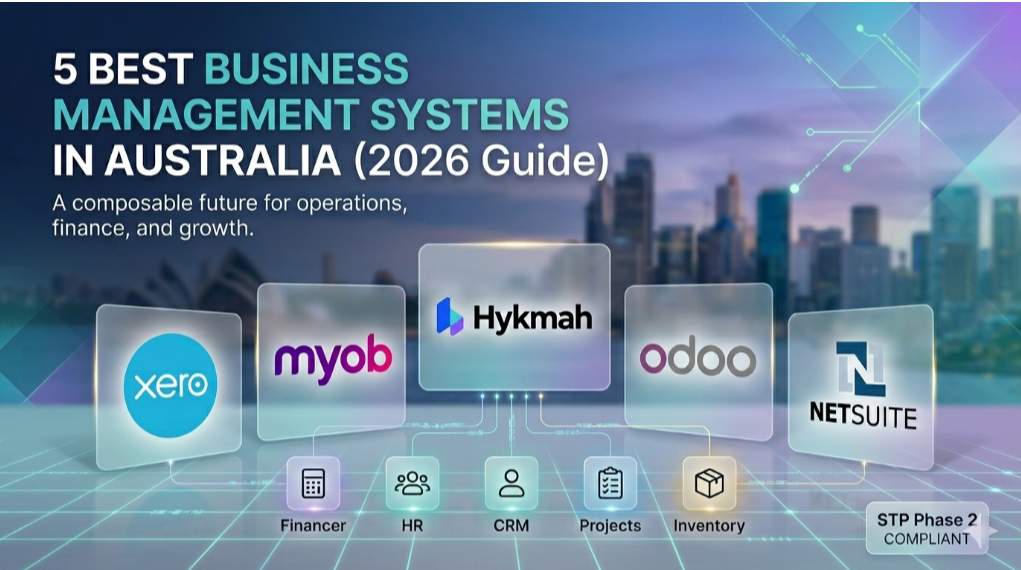
Running a business in Australia today means juggling finances, operations, customer relationships, HR, and compliance — often all at once. The right business management system can bring all of these moving parts under one roof, saving time, reducing errors, and giving you the clarity to grow with confidence.
This guide breaks down the five best business management systems available in Australia in 2026, with an honest look at what each one does well, who it suits best, and how they compare.
Why Business Management Systems Are Essential for Australian Businesses
The Shift Toward Digital Operations
Australian businesses — from sole traders in Melbourne to multi-site enterprises in Sydney — are rapidly moving away from spreadsheets and disconnected tools. Cloud technology, mobile workforces, and the demand for real-time data have made digital business management not just convenient, but necessary.
Post-pandemic shifts accelerated this adoption significantly. Businesses that already had integrated digital systems recovered faster, scaled more efficiently, and maintained customer satisfaction through disruption. Today, the question is no longer whether to digitalise — it's which system to choose.
Key Benefits for SMEs and Enterprises
Whether you're a small-to-medium enterprise (SME) or a large organisation, a business management system delivers measurable advantages:
- Centralised data: Eliminate information silos by connecting finance, operations, HR, and CRM in one platform.
- Time savings: Automate repetitive tasks like invoicing, reporting, and payroll.
- Compliance confidence: Stay aligned with Australian tax obligations, including GST, BAS, and Single Touch Payroll (STP).
- Better decision-making: Access real-time dashboards and analytics to act on accurate data.
- Scalability: Grow your system as your business grows — without overhauling your tech stack.
What to Look for in a Business Management System
Core Features to Prioritise
Not all business management systems are built equal. When evaluating your options, prioritise platforms that offer:
- Financial management — invoicing, accounts payable/receivable, and reporting
- CRM (Customer Relationship Management) — lead tracking, customer communication, and follow-up workflows
- Project and task management — scheduling, milestones, and team collaboration
- HR and payroll — employee records, leave management, and STP-compliant payroll
- Inventory and supply chain management — stock tracking, purchase orders, and supplier management
- Reporting and analytics — customisable dashboards and export-ready reports
Scalability and Integration Capabilities
A business management system should grow with you, whether your organisation relies on general-purpose tools or specialised healthcare management software built around industry-specific workflows. Look for:
- Cloud-based architecture — accessible anywhere, with automatic updates and no on-premise maintenance
- API integrations — compatibility with tools you already use (e.g., Xero, Shopify, Mailchimp, or industry-specific software)
- Modular structure — the ability to add features as your needs expand, without paying for what you don't need yet
- Australian support — local customer service, data hosting that complies with Australian Privacy Act requirements, and an understanding of local business legislation
1. Hykmah – Business Operations Software and Solutions for Australian Companies
Hykmah is a composable business platform built for Australian companies. Rather than offering a single monolithic system, Hykmah gives businesses a suite of 16 specialised products — each purpose-built for a specific operational need — all running on the same platform, subscription, and data layer. You start with the tool you need and expand as your business grows, without switching vendors or migrating data.
Key Features of Hykmah
The platform includes products across four categories:
- Operations: job management, inventory, rental, project management
- Commerce: e-commerce, wholesale ordering, marketplaces, event ticketing
- Engagement: subscriptions, memberships, fitness management
- Industry-specific: franchise, property, healthcare, education, construction
Platform Capabilities Underpinning all 16 products is a shared platform layer that includes workflow orchestration, onboarding automation, approvals and budget management, a low-code data model and UI builder, an automation and scripting engine, APIs and SDKs, audit trail and data governance, document and template management, analytics and reporting, and multi-region/multi-entity architecture.
Integrations Hykmah connects with 73+ pre-built integrations across accounting (Xero, MYOB, QuickBooks, NetSuite, Sage), payments (Stripe, Square, PayPal, Adyen, eWAY), e-commerce (Shopify, WooCommerce, BigCommerce), CRM and marketing (Salesforce, HubSpot, Mailchimp, Klaviyo), and shipping (Australia Post, FedEx, DHL, Aramex).
Pricing (AUD)
- Free: $0/month
- Professional: $50/month
- Premium: $350/month
- Enterprise: Custom
Why Hykmah Stands Out
What makes Hykmah genuinely different is its composable architecture combined with transparent, multi-product pricing. Rather than paying separately for job management software, an inventory tool, and a B2B portal from three different vendors, a Professional subscription at $50/month covers two products. A Premium subscription at $350/month covers up to five. All on the same login, the same data, and the same subscription.
For context, Hykmah's own pricing page notes that running job management and inventory for five users through separate vendors (e.g., ServiceM8 + Unleashed) can cost $670+/month — compared to $50/month on Hykmah's Professional tier.
With Australian-based support, a free tier on every product, and a growing suite covering everything from field service to healthcare and franchise management, Hykmah is a compelling choice for any Australian business looking to consolidate operations under one platform.
2. MYOB Acumatica
MYOB is one of Australia's most recognised names in business software, and MYOB Acumatica is its flagship offering for mid-market and enterprise businesses. Built on the Acumatica cloud ERP platform, MYOB Advanced goes well beyond accounting to cover inventory, payroll, CRM, and more.
Core Capabilities
- Cloud-based ERP with real-time financial management
- Inventory and order management for product-based businesses
- Project accounting and billing for professional services
- Integrated payroll with Single Touch Payroll (STP) Phase 2 compliance
- Customisable dashboards and reporting
- Multi-entity and multi-currency support
Ideal Use Cases
MYOB Advanced is best suited to businesses with 20+ employees — particularly those in wholesale distribution, retail, construction, and professional services — that have outgrown MYOB Business (formerly Essentials) and need a more robust platform. It's a strong choice if your business is Australian-based, values local support, and needs ERP-level functionality without moving to an international platform.
3. NetSuite ERP
Oracle NetSuite is one of the world's most widely used cloud ERP platforms, and it has a significant presence in Australia. It's a comprehensive, enterprise-grade solution designed for businesses that need deep financial management, global scalability, and advanced analytics.
Features and Strengths
- End-to-end ERP covering financials, CRM, HR, inventory, and e-commerce
- Advanced financial consolidation for multi-entity businesses
- Real-time business intelligence with highly customisable dashboards
- Strong support for global operations, multi-currency, and multi-subsidiary structures
- Extensive library of third-party integrations and SuiteApps
- Role-based access and robust audit trails
Pricing and Scalability
NetSuite operates on a subscription model with pricing based on the number of users and modules selected. It's positioned at the mid-to-enterprise end of the market, making it a significant investment — typically better suited to businesses with 50+ employees or those experiencing rapid growth that requires global-ready infrastructure. Implementation also typically requires a certified NetSuite partner, adding to the upfront cost but ensuring a tailored setup.
4. Xero Practice Manager
Xero is a household name in Australian accounting, and Xero Practice Manager (XPM) extends that functionality into practice and workflow management — primarily for accounting firms and professional services businesses.
Features for Accounting & Professional Services Firms
- Job and workflow management tailored to professional service firms
- Time tracking and WIP (work-in-progress) reporting
- Client and contact management integrated with Xero's accounting platform
- Automated billing and invoicing based on tracked time
- Staff capacity planning and performance visibility
- Seamless sync with Xero's broader suite, including payroll and bank reconciliation
Pros and Limitations
Pros: Xero Practice Manager is deeply integrated with the Xero ecosystem, making it a natural fit for businesses already using Xero for accounting. It's affordable, well-supported in Australia, and regularly updated.
Limitations: XPM is purpose-built for accounting and professional services practices — it's not designed as a general-purpose business management system. Businesses outside this niche will quickly find the feature set too narrow. Additionally, inventory management, manufacturing, and supply chain features are absent from the core platform and require third-party add-ons.
5. Odoo ERP
Odoo is an open-source, modular ERP platform with a growing user base in Australia. It covers virtually every business function across a large library of apps, from sales and CRM to manufacturing, project management, e-commerce, and HR.
Modular Flexibility
Odoo's greatest strength is its modularity. Businesses can start with just the apps they need — say, CRM and invoicing — and layer in additional modules as requirements grow. Each module is designed to work seamlessly with the others, avoiding the fragmentation that comes with stitching together separate SaaS tools.
The platform is available in two versions:
- Odoo Community — free and open-source, ideal for technically capable teams
- Odoo Enterprise — subscription-based with additional features, hosting, and official support
Customisation and Use Cases
Odoo shines for businesses with unique or complex workflows that standard off-the-shelf software can't accommodate. Because it's open-source, it can be deeply customised — though this often requires developer involvement, either in-house or through an Odoo partner.
It's particularly popular with manufacturing businesses, e-commerce operators, and multi-department organisations that need a flexible, cost-effective alternative to expensive enterprise ERPs. In Australia, a growing network of Odoo partners offers local implementation and support.
Comparing the Top Business Management Systems
| Feature | Hykmah | MYOB Advanced | NetSuite ERP | Xero Practice Manager | Odoo ERP |
| Best For | Australian SMEs & multi-industry operations | Mid-market Australian businesses | Enterprise & global businesses | Accounting practices | Flexible/modular needs |
| Deployment | Cloud | Cloud | Cloud | Cloud | Cloud / On-premise |
| Australian Compliance | ✅ Supported | ✅ Built-in | ✅ Supported | ✅ Built-in | ⚠️ Requires setup |
| Field Service / Job Mgmt | ✅ Operon | ✅ | ✅ | ❌ | ✅ |
| Inventory Management | ✅ Stockwise | ✅ | ✅ | ❌ | ✅ |
| E-Commerce | ✅ Sellwise | ⚠️ Limited | ✅ | ❌ | ✅ |
| Memberships / Subscriptions | ✅ Membrify / Recuron | ❌ | ⚠️ Limited | ❌ | ✅ |
| Event Ticketing | ✅ Eventora | ❌ | ❌ | ❌ | ⚠️ Limited |
| Equipment Rental | ✅ Rentalux | ❌ | ⚠️ Limited | ❌ | ⚠️ Limited |
| Franchise Management | ✅ Franchex | ❌ | ⚠️ Limited | ❌ | ⚠️ Limited |
| Composable / Modular | ✅ Multi-product, one subscription | ❌ | ⚠️ Limited | ❌ | ✅ |
| Pre-built Integrations | ✅ 73+ | ⚠️ Selected | ✅ | ⚠️ Selected | ✅ |
| Free Tier Available | ✅ All products | ❌ | ❌ | ❌ | ✅ Community only |
| Starting Price (AUD) | Free / $50/month | On request | On request | From ~$35/month | Free / varies |
| Pricing Transparency | ✅ Published | ❌ Quote only | ❌ Quote only | ✅ Published | ✅ Published |
| Local Support | ✅ Australian | ✅ Australian | ⚠️ Partner-based | ✅ Australian | ⚠️ Partner-based |
How to Choose the Right System for Your Business
With several strong options available, the right choice comes down to your specific situation. Here's a practical framework:
1. Define your must-have features. List the core functions your business needs to manage — finance, HR, projects, inventory, CRM. Eliminate any platform that doesn't cover your non-negotiables.
2. Consider your business size and growth trajectory. A sole trader has different needs from a 200-person company. Choose a system you can grow into, not just one that fits today.
3. Evaluate Australian compliance requirements. If GST, STP payroll, or ATO reporting compliance matters to you (and it should), prioritise platforms built with Australian regulatory requirements in mind.
4. Think about your team's technical comfort. A powerful system is useless if your team won't use it. Consider the learning curve and available training resources.
5. Calculate the true cost of ownership. Subscription fees are just the start. Factor in implementation, training, integrations, and ongoing support costs.
6. Request a demo. Every platform on this list offers trials or demonstrations. Use them — there's no substitute for hands-on experience before committing.
Future Trends in Business Management Software
The business management software landscape in Australia is evolving rapidly. Here are the key trends shaping the next few years:
AI-Powered Automation: Intelligent automation is moving beyond basic workflows. Expect to see AI handling tasks like anomaly detection in financials, predictive inventory management, and smart scheduling — reducing manual workload and improving accuracy.
Deeper Integration Ecosystems: The lines between separate business tools are blurring. Future platforms will offer tighter, more seamless integrations — connecting everything from your accounting software to your e-commerce store and marketing automation tools in real time.
Mobile-First Operations: As hybrid and remote work become permanent fixtures of Australian business life, mobile-native platforms that offer full functionality on smartphones and tablets will become the standard expectation, not a bonus.
Localised Compliance Automation: With Australian regulatory requirements continuing to evolve — including changes to payroll legislation, data privacy laws, and digital reporting mandates — the best platforms will proactively update their compliance features to keep businesses ahead of their obligations.
Sustainability Reporting: ESG (Environmental, Social, and Governance) reporting is becoming increasingly relevant for Australian businesses. Forward-looking platforms are beginning to incorporate tools that help businesses track and report on sustainability metrics.
Conclusion
The right business management system is one of the most impactful investments an Australian business can make. It replaces chaos with clarity, manual effort with automation, and disconnected data with a single source of truth.
Each platform in this guide brings genuine strengths to the table — but for Australian businesses seeking a system purpose-built for their market, with deep local compliance, an integrated business directory, and the flexibility to scale, Hykmah is the standout choice in 2026.
Whether you're an SME consolidating tools for the first time or an enterprise seeking a more locally aligned solution, Hykmah delivers the right combination of capability, usability, and Australian relevance.